A working town of 51,000 people on the slopes above Cannes, with a protected old centre, perfume heritage recognised by UNESCO and hamlets where land and views still cost less than on the coast.
Overview
Grasse is the largest town in the hills behind Cannes. INSEE counted 50,970 inhabitants in 2023 across a commune of 44 km² that rises from about 80 metres on its southern edge to the limestone heights above the town. It is a place where people work, shop and go to school all year.
The town's identity is perfume. In 2018 UNESCO inscribed the skills linked to perfume in the Pays de Grasse on its Representative List of the Intangible Cultural Heritage of Humanity: the growing of perfume plants, the knowledge and processing of natural raw materials and the art of composing a fragrance. The Musée International de la Parfumerie occupies the Hôtel de Pontevès in the centre. The flower calendar still shapes the year, with the Expo Rose in May and the Fête du Jasmin on the first weekend of August, held every year since 1946.
The old town is closely protected. Its secteur sauvegardé was created on 26 November 1974 and is governed by a Plan de Sauvegarde et de Mise en Valeur; under the 2016 heritage law it is now a site patrimonial remarquable. Façades, roofs and even interior works there need the approval of the Architecte des Bâtiments de France.
Neighbourhoods and hamlets
The commune is large enough to hold several distinct places, each with its own chapel and character.
Magagnosc lies to the east at around 400 metres and is recorded as early as 1248. Its houses sit on terraced slopes that face south over the coast. Its hamlets spent centuries in legal disputes with Grasse to win their autonomy. Today it is a sought-after residential area for buyers who want a view and a garden while staying a few minutes from the town centre. Grasse has two postcodes, 06130 and 06520, so check which one a property carries when you search.
Plascassier is the most outlying hamlet, at about 300 metres on a promontory to the south-east, surrounded by farmland and bordering Valbonne. It has had its own parish since 1770. Édith Piaf died there in 1963. Its position makes it the part of Grasse closest to Sophia Antipolis.
Saint-Jacques, Saint-Antoine, Saint-Mathieu, Sainte-Anne and Saint-Claude are quartiers named after their chapels; Saint-Jacques lies along the road to Auribeau. Les Aspres is crossed by the Canal de la Siagne on steep, rocky hillsides. Le Plan, attached to Grasse in 1743, groups several sectors including La Paoute and Sainte-Marguerite.
Property and prices
Grasse
Sales recorded
Median price per m²
Median price
Sales of €1m or more
Sales of €2m or more
Houses
388
€4,870
€450,000
40
5
Flats
1103
€3,030
€170,000
0
0
Source: DVF sales records (DGFiP, data.gouv.fr), sales from 1 January 2024 to 31 December 2025; single-house and single-flat sales of at least €50,000 and 20 m². Median price per m² of built area.
Between 1 January 2024 and 31 December 2025 DVF recorded 388 house sales in Grasse at a median of €4,870 per m² of built area and a median price of €450,000, alongside 1,103 flat sales at a median of €3,030 per m². Those are the lowest house figures of the hill towns we cover: Opio recorded €7,090 and Châteauneuf-Grasse €6,950 over the same period. Forty houses sold for more than €1 million, five for more than €2 million and the highest sale was €4.3 million. In practice this means buyers can find more land and more space for their budget here, while houses with open views on the Magagnosc and Plascassier slopes can sell well above the town median.
The housing stock is mixed: town houses and apartments in the old centre, nineteenth-century maisons de maître with gardens on the edge of town, villas built from the 1960s onwards on terraced plots and a smaller number of contemporary architect houses. On hillside plots ask early about the PLU zone, access for fire services and the natural risks statement in the diagnostics; our guides on pools, extensions and planning and property diagnostics explain what to look for.
Who buys here
Grasse suits buyers who want a real town rather than a resort: families who need schools and services on the doorstep, people working in Sophia Antipolis or Cannes and international buyers who would rather have a large garden and a view than a smaller plot nearer the sea. Those who prefer quieter villages with higher prices per m² often compare it with Opio, Le Rouret and Châteauneuf-Grasse or Valbonne.
Schools and services
The town has two public lycées, the Lycée Amiral de Grasse on avenue Sainte-Lorette and the Lycée Alexis de Tocqueville on chemin de l'Orme, as well as the private Lycée Fénelon. Families looking for international programmes usually look towards Valbonne and Mougins; our international schools guide lists them.
Markets are part of the weekly routine. On Wednesdays stalls fill the Cours Honoré Cresp; on Saturdays the food market sets up on the Place aux Aires and Place Morel; in July and August an evening market runs on Thursdays. Golfers have the 18-hole Golf du Claux-Amic within the commune and the Golf de la Grande Bastide next door in Châteauneuf-Grasse.
Getting around
Grasse is the terminus of the Cannes to Grasse railway, closed in the twentieth century and reopened in 2005. TER trains run roughly hourly through Cannes, with some continuing to Antibes and Nice. By road the pénétrante Cannes-Grasse links the town to the A8 motorway at exit 42; the Route Napoléon climbs north towards the Alps.
Measured by road distance, the centre of Grasse is about 36 km from Nice Côte d'Azur airport, roughly 40 to 45 minutes outside peak hours; it is about 14 km from Sophia Antipolis, roughly 20 to 25 minutes. Magagnosc is about 30 km from the airport and 12 km from Sophia. Plascassier is the best placed: about 26 km from the airport and 8 km from Sophia, typically 10 to 15 minutes; our guide to moving to Sophia Antipolis compares the commuter towns.
Homes for sale in Grasse
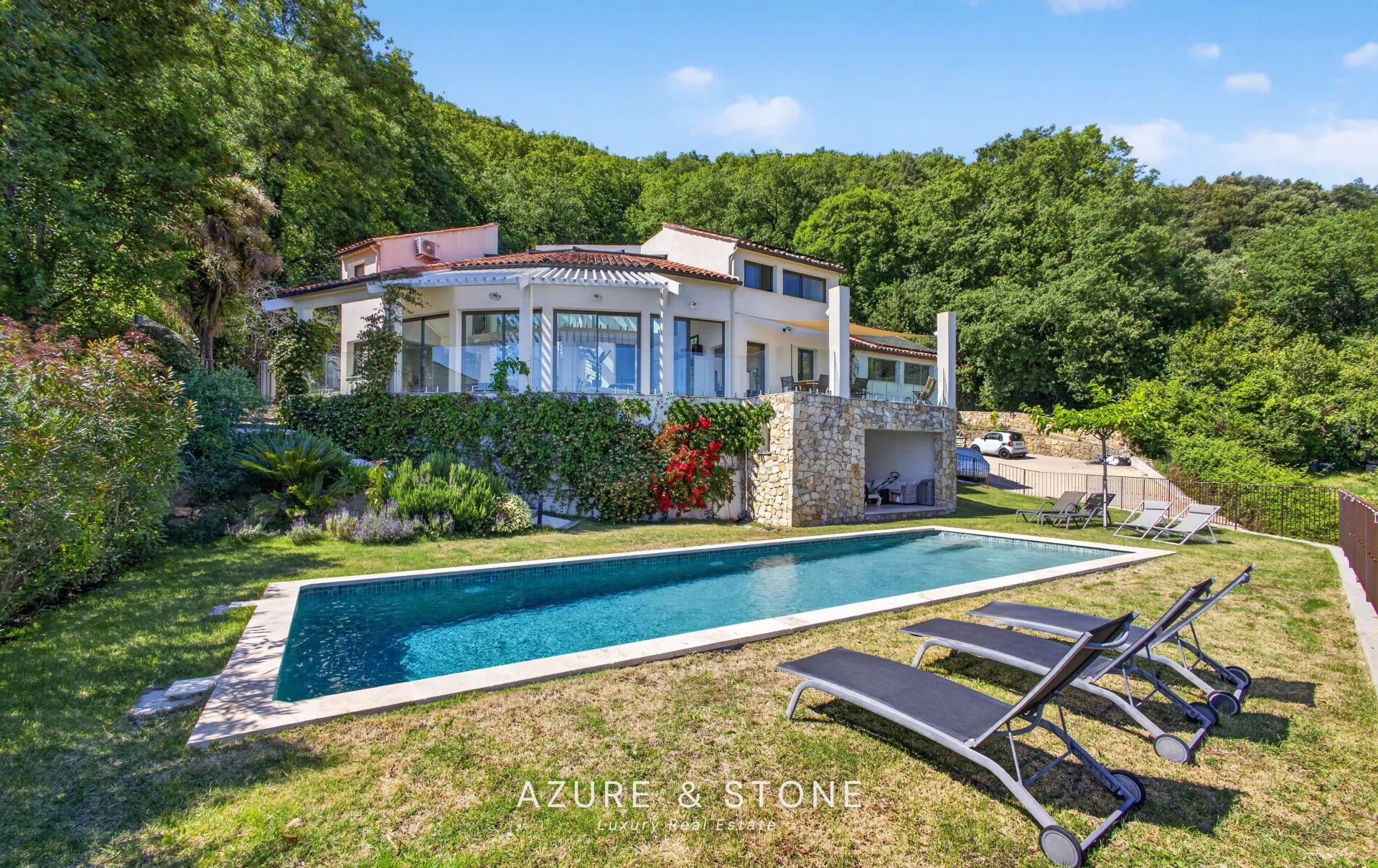
We present homes with our partner agent Azure & Stone Immobilier, including a contemporary villa on the heights of Magagnosc. Current listings for this area appear below. If you are looking for something specific, a search mandate or the off-market register lets us look on your behalf.
Contemporary architect-designed villa on the heights of Magagnosc above Grasse, oriented towards panoramic sea and valley views. Four bedrooms each with a shower room plus an office, and a pool with pool house in a south-facing plot of about 6,765 m².
4 bedrooms215 m²Pool
1 395 000 €
Frequently asked questions
How much does a house cost in Grasse?
DVF records a median of €4,870 per m² and a median price of €450,000 for the 388 houses sold in Grasse between January 2024 and December 2025. Homes with land and open views in Magagnosc or Plascassier can sit well above that median.
Are Magagnosc and Plascassier part of Grasse?
Yes. Both are hamlets of the commune of Grasse, with their own churches. Magagnosc lies to the east of the centre and Plascassier to the south-east towards Valbonne.
Can I reach Grasse by train?
Yes. Grasse station is the end of the line from Cannes, with TER trains roughly every hour. Some services run through to Antibes and Nice without a change.
How far is Grasse from Nice airport?
About 36 km by road from the town centre, which takes roughly 40 to 45 minutes outside rush hour. Plascassier is closer, at about 26 km.
Can I renovate a house in the old town of Grasse freely?
No. The historic centre is a site patrimonial remarquable governed by a Plan de Sauvegarde et de Mise en Valeur, so most exterior and many interior works require the approval of the Architecte des Bâtiments de France. Ask your notaire to check the rules before you sign.